

In France, there’s a moment in the day when time seems to slow down, when the clock strikes four, and everyone, young and old, knows what it means.
Le goûter, or “le quatre-heures,” as it’s affectionately called in France, is that magical time of the day to celebrate with something sweet. The same pleasure, shared by children and grown-ups alike, a little indulgent break in the middle of the afternoon, just enough to bridge the hunger gap before dinner arrives a few hours later.
A tradition every French family knows, or once knew, at least as children. As adults, life sometimes makes us forget: work, schedules, rushing… le goûter then becomes a luxury, a moment of calm. An occasion to pause, to breathe, to treat yourself, to catch up with loved ones over a cup of tea or coffee and a few delightful gourmandises. An institution culturelle in its own right.

Indulgent goûter at home
But for most of us, le goûter also carries a wave of childhood nostalgia, a true Madeleine de Proust. Just a smell, a texture, or a taste can take you straight back to those simple, comforting moments. For me, it was the snack my mum tucked into my schoolbag for the quatre-heures, that I would unwrap impatiently in the playground. And then there were the afternoons when my dad picked me up from school and made a detour by the bakery, buying me a friand or a croissant aux amandes. I can still remember the smell of the pastry filling the car, and the quiet joy of that small shared treat before heading home.
Now that I live in England, le goûter has taken on an even more precious meaning when I visit my family in France. It’s what I share with my sister when we meet for a catch-up in her garden, with my mum when we sit together on our favourite terrace in Rouen, or with the whole family when everyone brings brioches from the bakery and homemade cakes. I watch my nieces with their eyes wide with delight, and I realise that we’re all children again for a moment, that the pleasure hasn’t changed, only the generations.


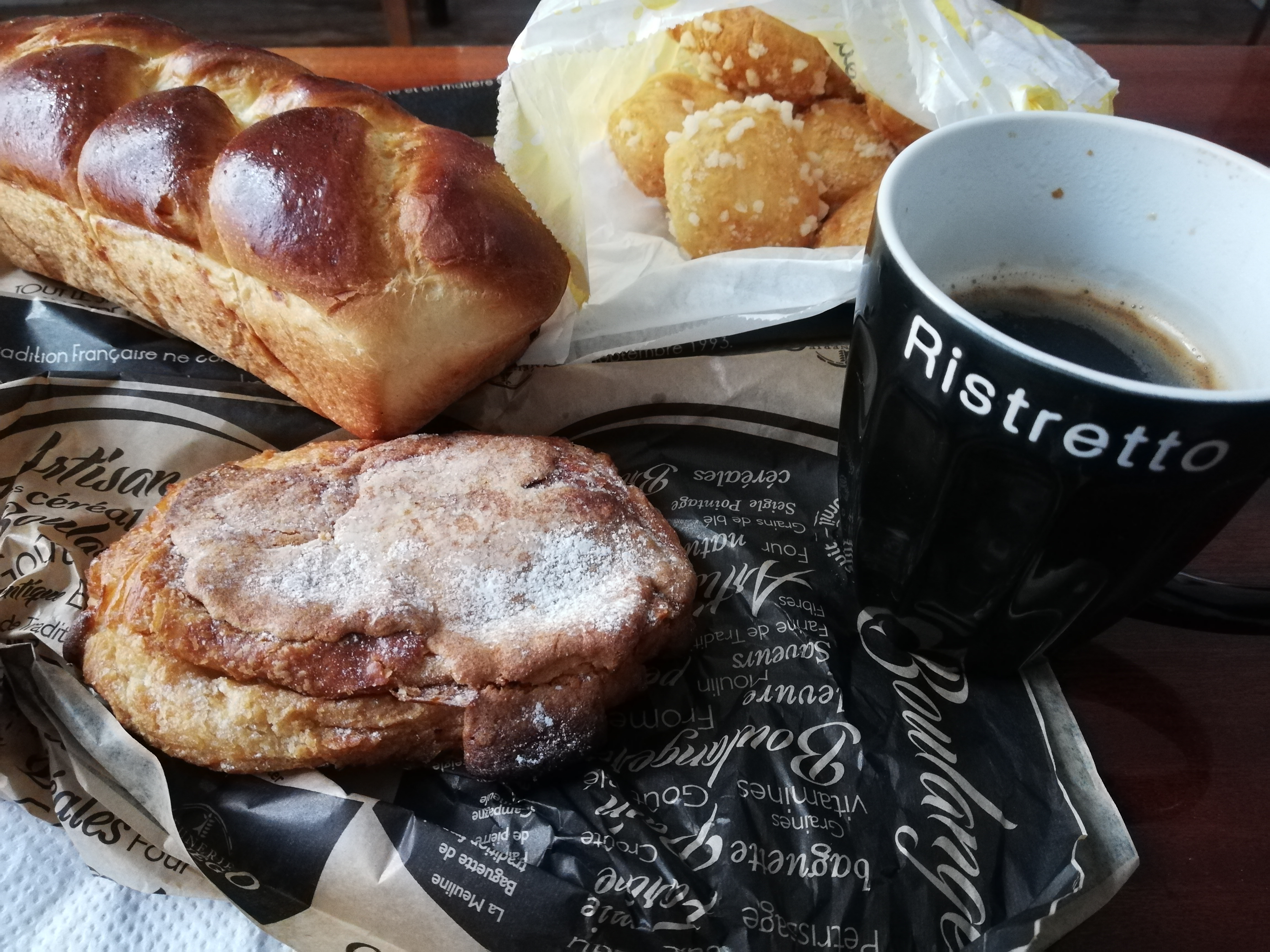
Goûter en famille : brioche, chouquettes, croissant aux amandes et pain au chocolat from the bakery
Pierre discovered the pleasure of le goûter quite recently, during a holiday in Normandy, invited in the afternoons for a little pause gourmande: a croissant by the river in a Norman village, or a rich cake and coffee on a sunny terrace. Now, he’s a convert, and how could he not be?
The ideal goûter? Whatever you want, wherever you want, however you like it, as long as it’s at 4 pm! Traditionally, it was nothing more than a slice of baguette with butter and jam or a few squares of chocolate tucked inside. But the French, true to their culinary creativity, soon let their gourmandise speak. Today, le goûter can mean brioche with jam or chocolate, viennoiseries, chouquettes (my favourite!), homemade cakes and tarts, or simply the timeless Petit Beurre biscuit.


Cosy goûter in a Café / Café Hamlet, Aître Saint-Maclou, Rouen
There’s also the simple joy of stepping into a bakery at l’heure du goûter. Even if there’s a queue, and there often is at that time, it’s a moment worth waiting for. The warm smell of freshly baked bread and pastries wraps around you as soon as you push the door open. You listen to the soft murmur of regulars chatting with the lady at the till and then comes the impossible task: choosing what you fancy. Everything looks tempting : golden croissants, glistening fruit tarts, rich cakes, and for a moment, you feel like a child again, eyes wide, trying to decide which small happiness to take home.


“Dame cakes”, bakery & tea room in Rouen / another bakery window in Rouen
At first, goûter didn’t happen in the afternoon at all. For centuries, it was taken in the late morning, a small break to recover strength during long working days that started early.
By the 18th century, small sweet bites began to appear at the end of meals and sometimes mid-afternoon, the famous petits fours, baked in the fading heat of ovens after the large roasts were done. As dinner (or souper) in noble and bourgeois circles was served later and later, a little collation naturally slipped into the mid-afternoon.
In the 19th century, le goûter became a true institution among the bourgeoisie, a social ritual, elegant and refined. Drawing rooms filled with delicate treats and fine pastries, marking the growing importance of this pause in French cultural life.

Le goûter au jardin public, huile sur toile, Victor Gilbert (wikipedia)
But le goûter was never only for the elite. During the Second World War, amid scarcity and rationing, it became a vital moment for children. Authorities and relief organisations ensured that the young would receive food at that time of day, a measure for both nutrition and morale. Archival posters from Le Secours National and Entr’Aide d’Hiver (1940–44) testify to this.

Archival posters from Le Secours National and Entr’Aide d’Hiver (1940–44) – Guilhermet
Around the world, while France holds le goûter close to its heart, other cultures share similar traditions. In Spain, la merienda takes place between 5 and 7 pm, a cherished daily ritual. In Italy, la merenda is a simple, sweet snack often enjoyed by children. In Japan, oyatsu (おやつ) marks a light snack time around 3 pm. And in the United Kingdom, afternoon tea offers a more ceremonial but equally delicious moment of pause.


Goûters at home in Corsica
As france-pittoresque.com beautifully reminds us (citing Le Plaisir de vivre, 1926):“Goûter veut dire déguster, se contenter de prendre connaissance de la saveur des aliments et, pour cela, quelques bouchées, une gorgée de liquide, peuvent suffire.”
Originally, then, it was a light, sensory pause, just a few bites, a few sips, to savour. But of course, being French, we couldn’t resist turning it into a full-blown moment de gourmandise. Many say le goûter is no longer necessary, that we eat enough already. But beyond nutrition, it remains something essential: a moment to stop, sit, breathe, and savour. In a world that moves ever faster, le goûter reminds us of something simple and deeply French: that pleasure, memory, and sharing are as nourishing as the treat itself.


Café Gourmand and Tarte au Citron from French Living restaurant
Although we don’t serve le goûter at the restaurant, as we are closed at quatre-heures, that same spirit lives in everything we make. It can be glimpsed in our café gourmand: a small coffee accompanied by a selection of mini desserts, perfect for tasting — a little “goûter” — and sharing. Every dessert, every cake, and tart is prepared the way our grandparents once did : simple, generous, and full of care. Recipes passed down, recreated, and shared, carrying with them that familiar taste of home and memory, the essence of le goût du vrai.
Leave a Reply